
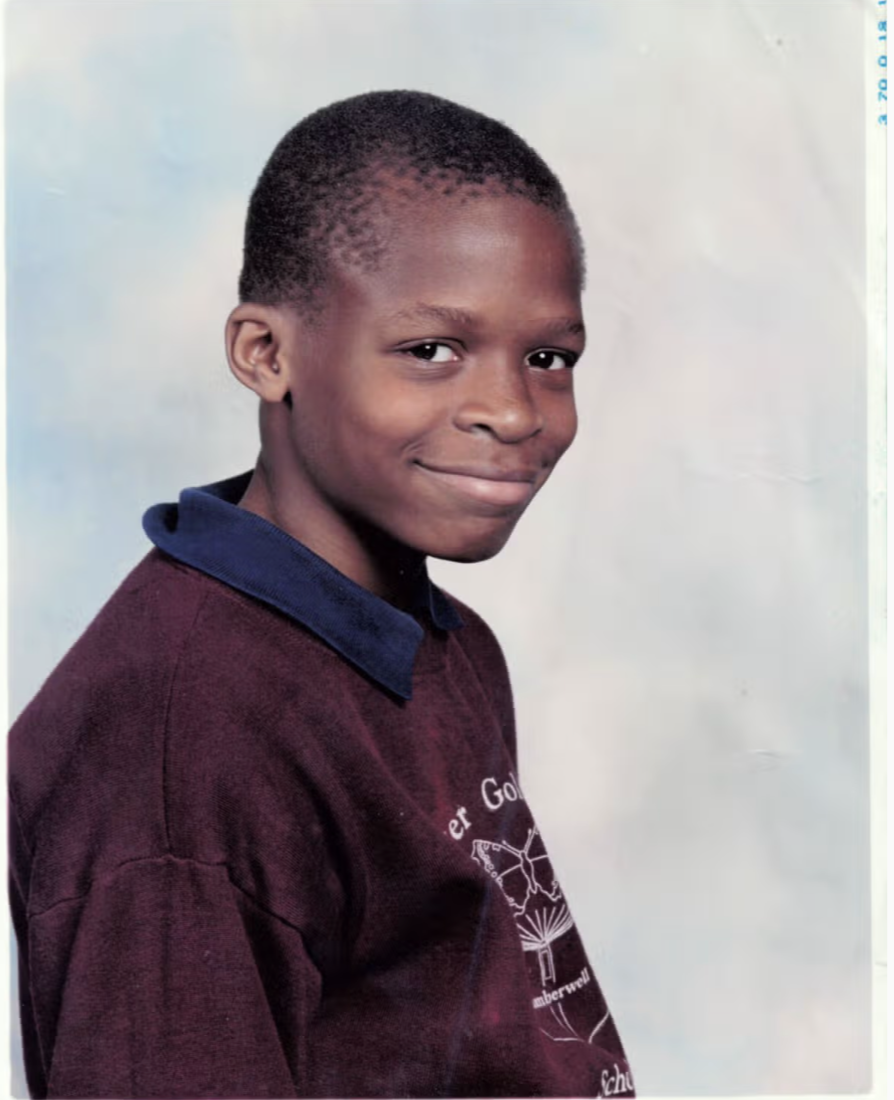
(Image via BBC/Optomen TV/Tunde Taylor)
The name ‘Damilola Taylor’ has been etched into the memories of many Black Brits forever. The circumstances surrounding his death shocked the nation. A 10 year old boy murdered in the stairwell of a block of flats by teenagers. His death brought renewed attention to youth violence, knife crime and the realities of what it meant to grow up as a child in inner-city South East London.
I was just four years old at the time, on 27 November 2000, but growing up, I remember the lasting impact that this story had particularly within many immigrant African families. Damiola had moved to the UK with his family, who had come seeking better medical treatment and opportunities for his sister, who suffered from a severe form of epilepsy. For many African families at the time, the West was often viewed as something of a utopia, a place that promised better living conditions, greater opportunities, improved outcomes and the possibility of a fresh start. The last thing you would expect when migrating to the West is to lose a child, let alone your 10 year old son.
The new documentary, Damilola: The Untold Story, offers a perspective from those who last saw him and paints a unique portrait of South East London in the 2000s. It explores multiple themes, including bullying, culture, life on an estate, policing, community, the experiences of Black inner-city children, survivors’ guilt, youth violence and lastly, hope and legacy.
Connecting the dots
On Sunday 18th October, community group ‘Sutmlight’ hosted an exclusive community screening and panel discussion of the documentary, bringing people together to unpack its weightier themes under the title ‘Connecting the dots’.
The panel brought together intergenerational audiences, community leaders and influential voices including former Met Police Superintendent Dr Lerory Logan MBE. Other key panellists included, Sayce Holmes-Lewis, community activist; Kenny Imafidon author, journalist and co-founder of research company Clearview; Johnson Situ, Director of the Co-Chairs Office & Diplomacy and Blessing Boyega, private executive assistant. The panel, hosted by Sports and Entertainment Presenter Samuel Leni, was pleasantly surprising. I left feeling hopeful. It was incredibly solution-oriented, equipping me with new perspectives and a clearer understanding of what more needs to be done as a community.
I particularly appreciated how the host allowed everyone a five-minute breather after collectively watching the documentary. She invited us to breathe in and out, releasing some of the tension we had carried throughout such a painful and tragic account. It was a thoughtful gesture, especially as I had anticipated just how emotionally heavy the documentary would be. From hearing Damilola's brother reflect on the regret of not being able to protect him, to Grace Boyega, Damilola's friend, wishing she had walked him home and John Boyega’s shock at the realisation that children could actually die, there were several moments in the documentary that were difficult to process. The collective tears, however, were also accompanied by laughter. John's humour brought a welcome lightness to the room, while the conversations offered a nostalgic reminder of what it was like to grow up in London: the familiarity of primary school, childhood friendships and the shared experiences of growing up with African parents.
Despite collectively revisiting such painful experiences and confronting difficult truths, I was left feeling optimistic. I felt a greater sense of understanding of the bigger picture and what Damilola's story represents. More importantly, I was reminded that we all have a part to play in ensuring that better care, support and provisions are in place for our young Black people. Each speaker on the panel brought their own unique perspective to the discussion, raising questions and exploring themes that challenged us to reflect on our individual and collective responsibilities. Ultimately, these are the conversations that can help us build a better future, not only for the young people growing up today but also for generations to come.
Why now?
Before the documentary commenced, we had the opportunity to hear from its producer, Nelson Adeosun. He was asked a few questions, including: Why now? Why this story? With so many different accounts and retellings of Damilola Taylor's story, what makes this particular documentary unique?
Nelson's response was that this is a story for everyone. It was something that resonated across Britain, with people from different backgrounds able to find some connection to it. He spoke about how even his own Nigerian parents were frightened by what had happened. For many first-generation Black immigrant families and young people, Damilola represented someone they could see themselves in. Nelson also reflected on how, while everyone seems to have their own recollection or similar version of Damilola Taylor's story, an entire generation has now grown up without knowing who he was or what happened to him. Nelson recognised the importance of making sure his story was not lost to time.
His intention was to allow people to see themselves on screen, to capture the joy and shared experiences of growing up as a Black community in Britain and to present an authentic account that went beyond the tragedy itself. He even mentioned that audiences might find themselves laughing at certain moments, something I hadn't anticipated but certainly experienced. It was a genuine reflection of what it can mean to be Black: finding moments of joy, humour and togetherness even beneath the weight of collective trauma.
One that particularly resonated was the account shared by a journalist who had written for The Telegraph. They recalled how the story of what had happened to Damilola had not quite resonated with the public until the newspaper published a photograph of him.
His smiling face was subsequently plastered across newspapers and featured prominently on front pages, changing the way the public engaged with the story. It was a striking illustration of the power of the media and the role imagery plays in humanising news stories. Suddenly, this wasn't just a report about a child who had been murdered. It was the story of a 10-year-old boy with a face, a smile, a family and a future that had been taken away. His beaming smile evoked an extraordinary amount of emotion. More than two decades later, that image remains deeply familiar to so many of us, leaving an enduring imprint on the nation's collective memory.
The documentary also explored the cautionary tale of a community where people remained silent about what they knew regarding the perpetrators, despite having knowledge of who was responsible. This silence stemmed from a deep-rooted lack of trust in the police, alongside fear of potential repercussions from those responsible.
We also learn how Black police officers were brought in to assist with house-to-house enquiries, in an effort to build trust, encourage residents to speak up and support the investigation.
The account of Damilola's eldest brother particularly broke my heart, as we hear how their father placed blame on him for his younger brother's death. It was a painful reminder that grief manifests itself in so many different ways. When we struggle to process pain or comprehend the magnitude of a loss, we sometimes search for explanations, draw our own conclusions or look for someone or something to make sense of what feels incomprehensible.
It took almost six years for those responsible for Damilola's death to be brought to justice, with the case going through multiple trials before convictions were secured. The emotional toll of this is unimaginable. A family is left to navigate the loss of a child while simultaneously enduring years of uncertainty, unanswered questions and an ongoing pursuit of justice. In many ways, the process can complicate the grieving journey, leaving families feeling as though they cannot fully begin to heal while so much remains unresolved.
The documentary also highlights the importance of forensic science in securing convictions, while demonstrating how missed or overlooked forensic evidence can have far-reaching consequences, potentially delaying justice and prolonging the pain experienced by those left behind.
Mentorship
As the documentary drew to a close, the first panellist we heard from was Kenny Imafidon, who shared an alarming observation: homicide rates and youth violence remain significant concerns and in many respects, things have arguably become worse since Damilola Taylor's death. In his view, a sense of order has been lost. He attributed much of this to a lack of positive role models, a growing sense of hopelessness and a culture in which people only seem to care when tragedy affects them personally.
Kenny didn't just highlight the problems; he was equally direct about the solutions. One statement that particularly resonated with me was: "Don't talk about something you do nothing about."
It made me think about how frequently we see people take to social media to express their opinions, criticise and highlight the many issues affecting our communities. Yet, when it comes to examining what is actually being done to address the very things people complain about, there is often very little to show. In Kenny's view, we need more men actively showing young people an alternative path. We need to change the narrative, expose young people to positive examples of success and demonstrate that there are different possibilities available to them.
He went as far as to challenge the men in the room, asking: "If you're a man and you're not mentoring one young Black boy, then what are you doing?" It was a direct challenge, but an important one. We need to question the role we are each playing and ask ourselves what we can do to become part of the solution.
More mentorship is needed. More men supporting other men. More people investing their time, experience and knowledge into the next generation. Kenny even suggested that those who have the capacity to do so should consider joining a school governing body and becoming involved in the decisions that shape young people's educational experiences. He also touched on the importance of the family unit, using an analogy that stuck with me: driving a car with one hand is never better than driving it with two. His point was that father figures play an integral role in a child's upbringing and that the presence of positive male influences matters.
One of the points I particularly appreciated was his assertion that trauma is an explanation, not an excuse. This got me thinking about children who grow up around violence and that they themselves are part of a system. In Kenny’s eyes it takes a village to raise a child and the system is the people.
Community
Leroy reflected on the initial police investigations, recalling how officers went from house to house making enquiries, yet residents were reluctant to speak. He highlighted the importance of representation, explaining that people are often more inclined to engage and communicate when they see someone who looks like them and can relate to their community.
This reinforced the importance of having organisations that are reflective of the communities they serve. Representation is not simply about appearances; it can play a significant role in building trust, fostering meaningful relationships and encouraging greater engagement. He also expressed concern that policing has, in many respects, gone backwards, with resource constraints contributing to the loss of progress that had previously been made.
He concluded by emphasising the importance of sowing the right seeds, giving back and investing in our communities. One question he left us to consider was: How do we get into people's hearts and minds to inspire the changes we want to see?
Root cause
Sayce echoed similar sentiments to Kenny, exploring the growing sense of hopelessness within communities and examining the underlying reasons young people become involved in gangs. He highlighted how many young people are searching for a sense of safety, belonging and empathy, often looking for these things in environments where they are unlikely to find them.
He also touched on issues surrounding pride and ego, calling on individuals to put these differences aside and come together for the greater good. He highlighted a wider issue within our communities: the need for greater ownership, accountability and collective responsibility. We need to take a more active role in reclaiming and investing in the communities we live in.
The lack of resources, care, support and adequate provisions creates an environment in which young people are increasingly vulnerable. We need more trusted role models who can help us unpack the experiences and circumstances driving trauma, understand its root causes and intervene before those experiences develop into further harm and violence.
Multi-generational approach
Johnson spoke about how, as Black people, we are not always taught to embrace vulnerability or feel comfortable sharing our stories. Yet there is so much power in allowing ourselves to be vulnerable. It is often the starting point for receiving help, finding support and creating meaningful connections with others.
He reflected on our shared experiences, journey and identity, expressing how proud he is to be from South London.
He also emphasised the importance of learning from older generations, particularly recognising how they mobilised, organised and came together to create change. He feels that something of this collective spirit has been lost over time and believes that adopting a more intergenerational approach could be invaluable in moving our communities forward.
Learning, he suggested, should be a two-way exchange. Younger generations have much to learn from the experiences and wisdom of those who came before them, while older generations can equally learn from the perspectives and experiences of younger people. It is through this exchange that we can begin to grow, strengthen our relationships and build more connected communities. Finally, he stressed the importance of understanding who holds decision-making power and identifying opportunities to influence the spaces where decisions affecting our communities are made. He encouraged us to become more vigilant, politically and socially engaged and willing to exercise our collective influence where necessary.
We’re all in this together
Drawing on her experiences of living and working in the US, Blessing shared some interesting observations about the differences between how Black Americans and Black Brits come together as communities.
In her view, Black Brits still have some way to go when it comes to collaboration and collective action. She believes that individual egos can often get in the way, with a desire to stand out or be the only person in the room sometimes taking precedence over working together.
She emphasised the importance of putting individual differences aside, recognising that collective progress requires collective effort. Ultimately, she believes that our ability to collaborate, support one another and work towards shared goals is fundamental to the survival and advancement of our communities.
A Life Beyond the Headlines
Throughout the documentary, Damilola is remembered as a young boy with a larger-than-life personality, someone whose ambitions extended far beyond the circumstances of his surroundings. He was defined not by where he came from, but by where he believed he was going.
Tags
@nillzmarco @alexthomasfilms @sayceholmeslewis @kenny.imafidon @jnsitu1 @samueleni@blessingboyega